tea.glass · sampling channel Stock tea for your shop · Encyclopedia · School · Atlas · Pu-erh EN · RU · · · FR · ES · AR
tea.glass
dry
wet
liquor
plantation

home · gaiwans

Gaiwans — 盖碗

Liuzhou 120ml fluted gaiwan

Liǔzhōu Léngwén Gài Wǎn

柳州棱纹盖碗

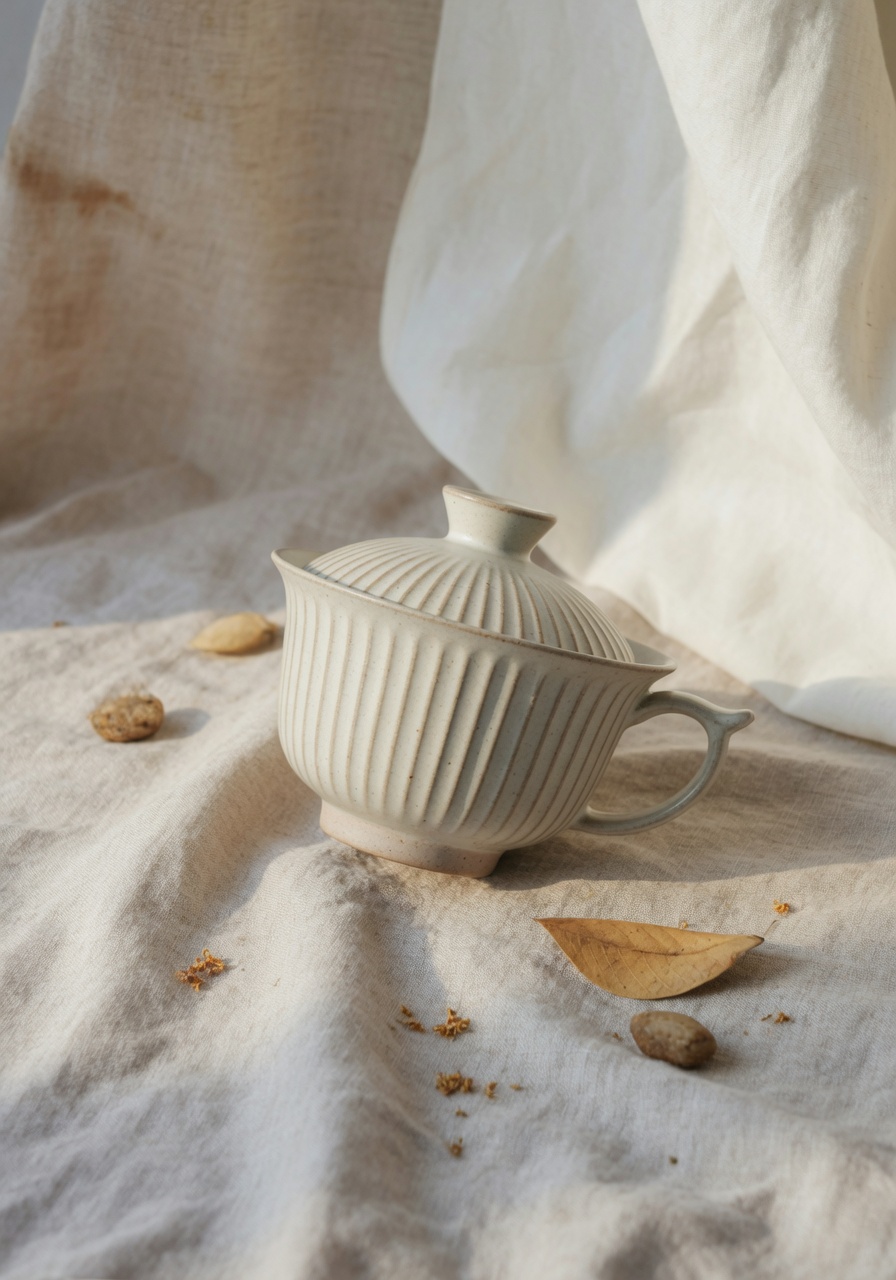
A 120ml hand-blown glass gaiwan with eight vertical flutes — the ribs catch the lid with a soft, audible register.

$95USD · 130 g

Weight
130 g
Harvest
Spring 2026
Processing
Hand-blown borosilicate, mold-flute formed, fire-polished rim, slow-annealed overnight
Sourced by

Ask about wholesale or a sample →

Twelve pieces a month, in a Liuzhou courtyard

Gao Lihua works alone in a converted shophouse two streets back from the Liu River, in Liuzhou, Guangxi. Trained first in industrial design, then for five years at a Murano studio outside Venice, she returned to Liuzhou in 2014 and has been blowing gaiwans under her own name since. Her output is intentionally tiny — twelve named pieces a month across her whole gaiwan and cup line, each logged in a paper ledger with a date, a buyer, and a one-line note about how the piece behaved on the pipe.

Michael Zhan visits her shophouse every quarter on his Guangxi route. He sources mostly Yunnan and Fujian leaf, but the glassware is a personal detour — he found Gao through a Liuzhou pu-erh trader in 2022 and has been buying her gaiwans for tea.glass since the second batch.

The fluted form is her own signature — an eight-ribbed graphite mould she designed for bái háo yín zhēn and other visual whites, where the flutes catch and refract the colour of the soup. She blows the parison into the mould, then opens the rim by hand on the marver. The flutes are functional as well as decorative — they give the lid a positive register so it seats with a small audible click instead of sliding, which matters when your thumb is wet and the bowl is full.

Walls run 1.6 to 2.1mm. Capacity is checked by water-fill against a marked beaker, then etched on the foot in Gao’s handwriting. The lot Michael selected in March 2026 is twenty-four pieces across two firings — the second firing ran slightly warmer and the rims pulled a touch finer.

The leaf, brewed

Not a tea — but here's how it behaves in the hand

dry leaf

Glass reads cool but not icy, faintly green at the rim where wall thickness drops to 1.6mm.

wet leaf

After a rinse the flutes hold a thin film of condensate that beads downward in even tracks.

liquor

Liquor reads honest — no green tint, no optical distortion across the 75mm bowl diameter.

aroma

Aroma lifts cleanly because borosilicate carries no glaze memory; first pour smells like the tea, not the vessel.

taste

Heat retention is moderate — wall is thinner than ceramic, so the second steep wants five extra seconds to compensate.

finish

Lid drops into the ribbed register with a small tick. No grinding, no slip on a wet thumb.

Brewing

A method, not a recipe.

Method
gongfu
Ratio
1g per 15ml (≈8g for full 120ml)
Water temp
85–100°C depending on tea
First infusion
10s after a 5s rinse
Subsequent
8–12 steeps, adding 5s per round after the fourth

Pre-warm with boiling water for thirty seconds — glass loses heat faster than porcelain, especially in winter.

Sourced by

Michael Zhan

Procurement & Sourcing Specialist (China)

Full profile →