From furnace apprentice to gaiwan maker
Liu Shenyang grew up in the courtyard of a glassworks. His grandfather, Liu Fuqing, opened the Handan shop in 1987, supplying laboratory beakers to a chemical institute two streets away. His father took over in the early 2000s and pivoted to lighting fixtures. Shenyang, born in 1989, was the first in the family to look at the furnace and see teaware.
He trained for seven years before touching a gaiwan. Apprenticeship in a Hebei glassworks is not romantic — it is hot, repetitive, and exact. He learned to read the colour of a gather, to count seconds between the marver and the bench, to anneal a thin wall without cracking. By twenty-three he could blow a 200ml pitcher to within two grams of target weight, eyes closed.
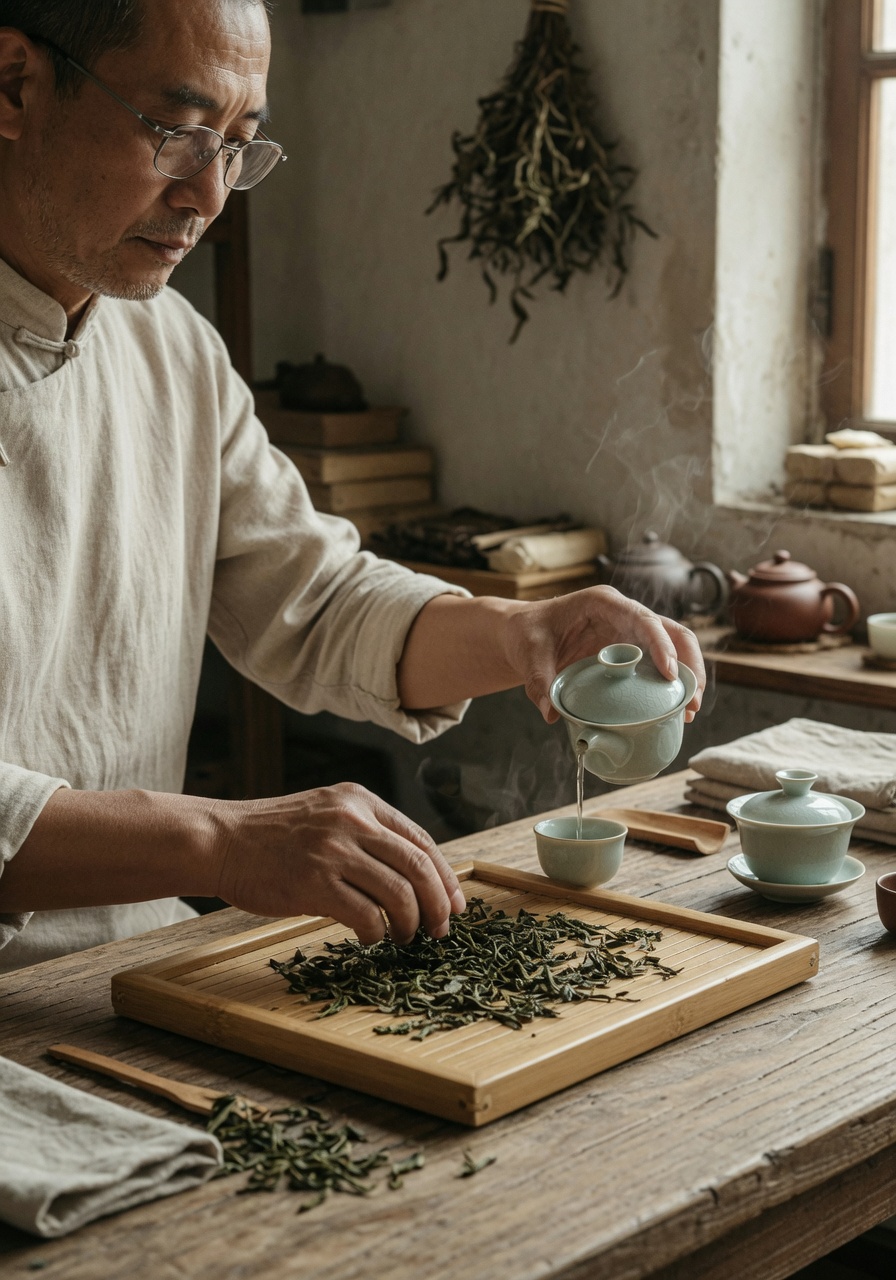
Tea entered slowly. A customer in 2014 — a Cháozhōu gongfu drinker visiting relatives in Handan — asked whether Shenyang could make a gaiwan with a flared, knife-edge rim. The first batch was wrong. The second was wrong. The fifth he kept for himself and brewed Mí Lán Xiāng (蜜兰香) from it every evening for a month, watching how the lid sat, where the liquor pooled, whether the rim cut his lip. He has been refining the same gaiwan ever since.
His teachers in tea are not in Handan. He travels twice a year — once to Chaozhou for dāncōng, once to a rotating destination. He studied gongfu service under a teacher in Shantou in 2017 and water temperature curves with a lǎo bái chá (老白茶) specialist in Fuding in 2019. He does not call himself a tea master in the lineage sense. The title, he says, is borrowed from the work itself: if you make the vessel, you must understand the brew.
The Handan workshop today employs four people. Shenyang’s mother books orders and grinds rims. His cousin runs the annealing oven. Two apprentices — both under twenty-five — handle gathering and base-blowing. Shenyang does every lid, every spout, every final rim. A 90ml gaiwan takes him roughly eighteen minutes from gather to anneal, with a six-hour cooldown afterward. The shop turns out perhaps eighty pieces a week.
What he is known for, among the small circle of Chinese collectors who have found him, is the rim. Handan glass is borosilicate — 3.3 expansion, the same as laboratory ware — but Shenyang fire-polishes every lip rather than cutting and grinding. The result is a softer edge, slightly thicker, that warms in the hand and does not chip when the lid is set down quickly. It is a quiet detail. Most buyers notice it only on the second pour.
He has no website. He has no Taobao shop. The pieces on tea.glass are the first time his work has been listed outside word-of-mouth and a closed WeChat group of about two hundred drinkers. He agreed to the partnership on one condition: that the listings name the workshop, not just the vendor.
Handan, and why the glass comes from here
Handan sits in southern Hebei, on the dry edge of the North China Plain. It is not a tea region. The nearest growing area of any reputation is several hundred kilometres south, and the city’s identity is industrial — steel, ceramics, coal. Glassmaking arrived in the twentieth century as a service trade to chemical and pharmaceutical works, which is why borosilicate, not soda-lime, dominates the local craft.
This matters for teaware. Borosilicate has a low coefficient of thermal expansion, which is the technical way of saying it does not crack when you pour boiling water into a cold cup. Soda-lime glass — common in cheaper teaware from Shandong and Anhui — survives most use but fails unpredictably under thermal shock. Shenyang’s workshop runs Schott 3.3 rod and tube stock, sourced through a Tianjin distributor who has supplied the family since 2003.
The workshop itself is a single-storey brick building behind the family courtyard. One gas furnace, one glory hole, two annealing ovens, a marver bench, and a small lathe for finishing. Sand-cast moulds are made in-house from a graphite-clay mix his father formulated; they last about three hundred pulls before the inner surface needs re-cutting. Lampwork — spouts, knobs, fine handles — happens at a side bench with twin oxygen-propane torches.
Water for the cooling tanks comes from the municipal supply, hard and mineral-heavy, which Shenyang considers irrelevant to the glass but interesting for the tea he brews on breaks. He keeps a kettle of bottled spring water at the bench for tasting. The light in the shed, filtered through frosted skylights, is the reason every product photograph on tea.glass was shot on-site rather than in a studio.